
One of the most complex challenges in scaling a tech company isn't the code, it's the capacity.
Do you hire aggressively and risk expensive downtime during slow cycles? Or do you keep the team lean and bottleneck your growth when a critical feature or market opportunity arises?
The answer lies in adopting the concept of the "Right-Sized" team, a development capacity framework that is flexible, efficient, and perfectly aligned with your current strategic goals. This approach allows you to scale your development capacity on demand without the financial or managerial overhead of traditional hiring.
🧭 The Core Concept: Static vs. Dynamic Capacity
Most companies operate with a Static Capacity model:
- Fixed Overhead: High salaries, benefits, and administrative costs.
- Slow Scaling: Takes months to hire, onboard, and integrate new talent.
- Inefficiency: Full-time staff may face "idle time" between major projects.
The goal of the "Right-Sized" framework is to move your organization toward a more Dynamic Capacity model, which offers Variable Overhead, Rapid Scaling, and Maximized Efficiency.
The 3 Pillars of the Right-Sized Team Framework
The framework determines the ideal team composition by assessing three critical pillars: Core, Surge, and Specialist.
Pillar 1: The Core (Your Internal Foundation)
The Core Team consists of your long term, internal employees. They are the guardians of your product vision, institutional knowledge, and core culture.
- Who They Are: CTO, Product Manager, Senior Architects, and key developers focused on mission critical features and foundational IP.
- The Role: They manage the roadmap, maintain the overall system health, and own the “Definition of Done”. Their focus is stability and long term quality.
- Capacity Strategy: This team should be kept lean and stable. Only hire internally for roles that require deep, continuous product context and high organizational fidelity. Never over staff the core for short term spikes.

Pillar 2: The Surge (Scaling Velocity On Demand)
The Surge Capacity is the flexible muscle you use to tackle large, time sensitive projects without distracting your Core Team. This is where on demand dedicated development teams shine.
- Who They Are: External teams (like Dev Teams On Demand) brought in for 6 to 12 month engagements focused on a specific goal.
- The Role: Velocity and Delivery. They execute high priority, time-boxed features, build new microservices, or tackle major infrastructure migrations (e.g., "Build the new mobile app" or "Migrate to a new database").
- Capacity Strategy: Elasticity. You staff the team to the exact size needed to hit the target date, and when the project is delivered, the capacity is safely ramped down. This protects your Core team from burnout and stops unnecessary long term hiring.

Pillar 3: The Specialist (Filling Critical Skill Gaps)
The Specialist Capacity is brought in for hyper specific, short duration tasks where internal expertise is lacking or too expensive to maintain full time.
- Who They Are: Fractional experts in niche fields (e.g., ML engineers, specific platform certification experts, high end DevOps architects).
- The Role: Focused Expertise. They complete a defined task, transfer knowledge to the Core Team, and exit. (e.g., "Implement a HIPAA compliant security layer" or "Set up an advanced Kubernetes cluster").
- Capacity Strategy: Precision. Use these experts only for the duration of the knowledge transfer or implementation. They prevent your team from making costly mistakes in unfamiliar territory.

📈 Implementing the Right-Sized Framework
Shifting to this dynamic model requires a strategic approach to planning and collaboration.
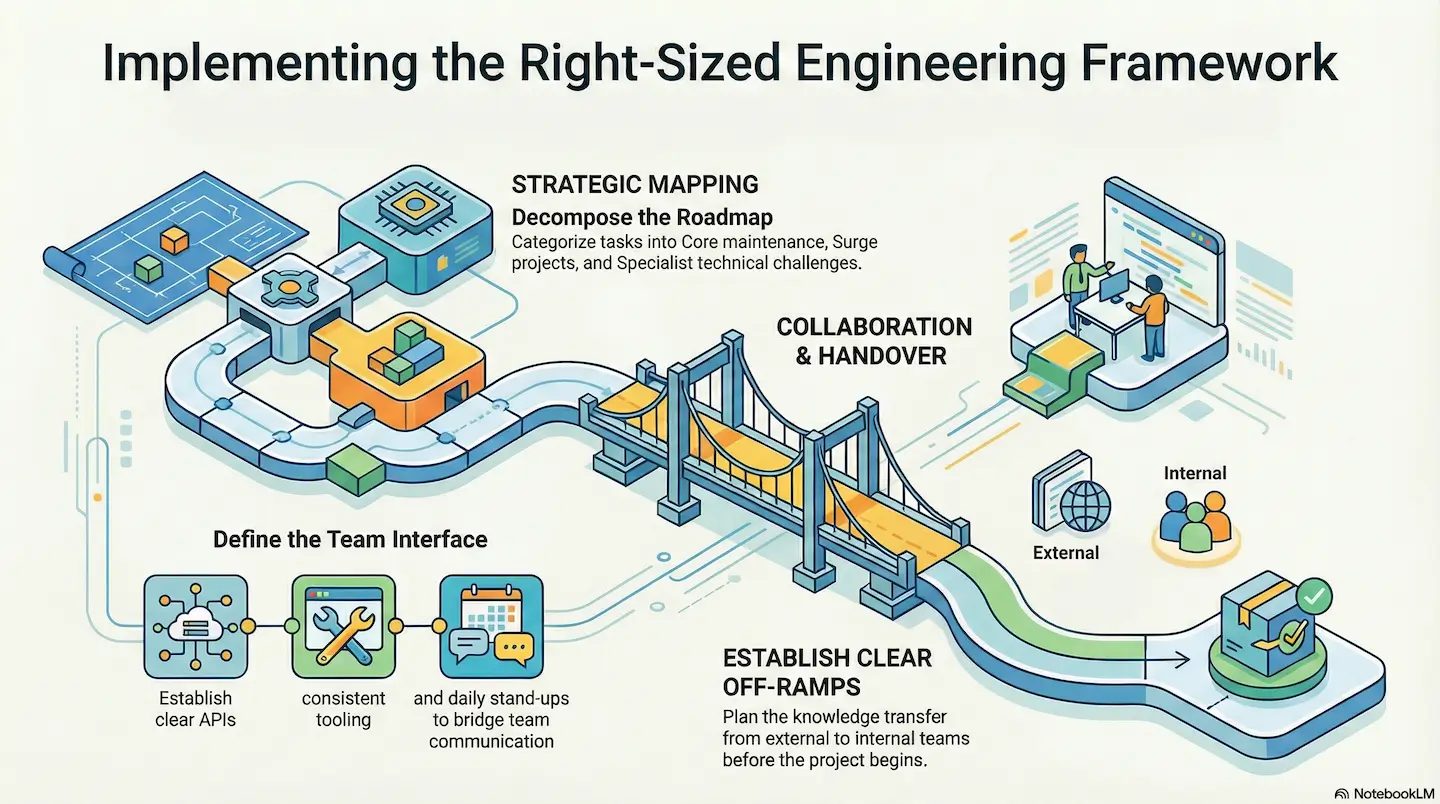
- Map the Work: Decompose your roadmap. Clearly separate ongoing maintenance and architectural tasks (Core work) from large, new projects (Surge work) and high risk technical challenges (Specialist work).
- Define the Interface: Establish crystal-clear APIs and communication protocols between the Core and Surge teams. Use consistent tools (Jira, GitHub), adhere to the Core Team's definition of "Done," and establish daily stand ups that bridge the two teams.
- Establish Clear Off Ramps: Plan the knowledge transfer from the Surge team to the Core team before the project even begins. This ensures your internal team can maintain the newly built product efficiently after the external team departs.
Build Smart, Not Just Big
Scaling blindly is risky and inefficient. The "Right-Sized" Team Framework ensures your development budget is spent on impact, not overhead. It empowers your internal leaders to focus on vision while leveraging flexible, world class external capacity to hit aggressive deadlines.
Ready to gain development flexibility and hit your growth targets faster?
At Dev Teams On Demand, we specialize in providing the agile, high-impact capacity you need to execute large projects rapidly, fill critical skill gaps, and ensure your application is architected for sustainable growth. Whether you need to rescue a struggling application, optimize cloud costs, or scale your team for enterprise readiness, we provide the solution.
👉 Contact us today to rapidly scale your development capacity and accelerate your growth roadmap.