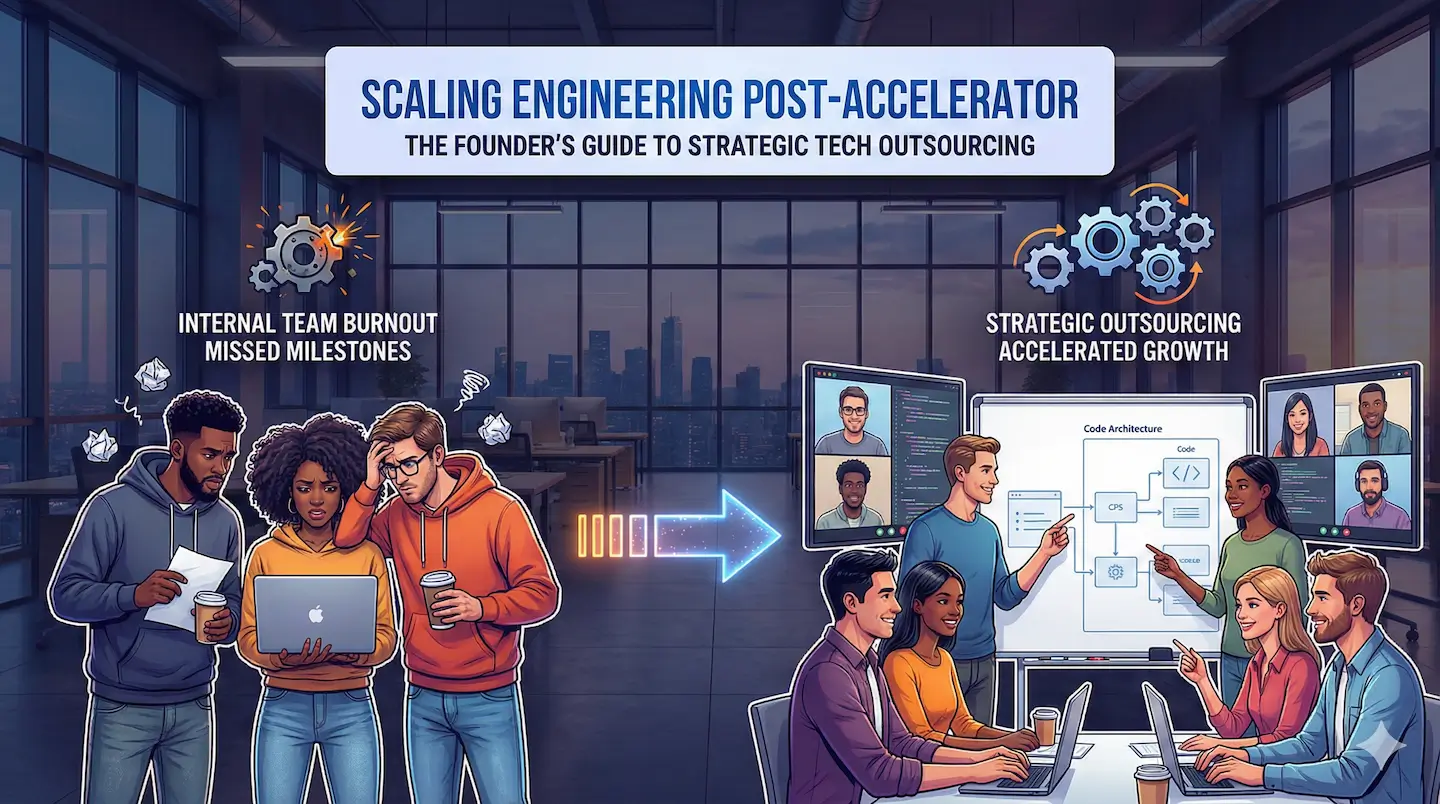
The Demo Day high has faded, the seed capital is in the bank, and your board expects rapid product iteration. In the fast-moving world of startup software development, founders and product leaders naturally want to handle everything in-house. Your core team knows the product best, and keeping development internal feels like the safest way to protect your vision.
But as your product complexity grows, scaling your engineering team with the required speed, specialized skills, and focus becomes a massive operational challenge. Here is the truth: outsourcing doesn’t mean replacing your core team or handing your proprietary product over to outsiders. In fact, trying to build everything internally usually leads to burnout and blown deadlines. The most effective post-accelerator strategy is balance. Keep your core product vision in-house while strategically leveraging external experts for specialized, time-sensitive, or non-core work.
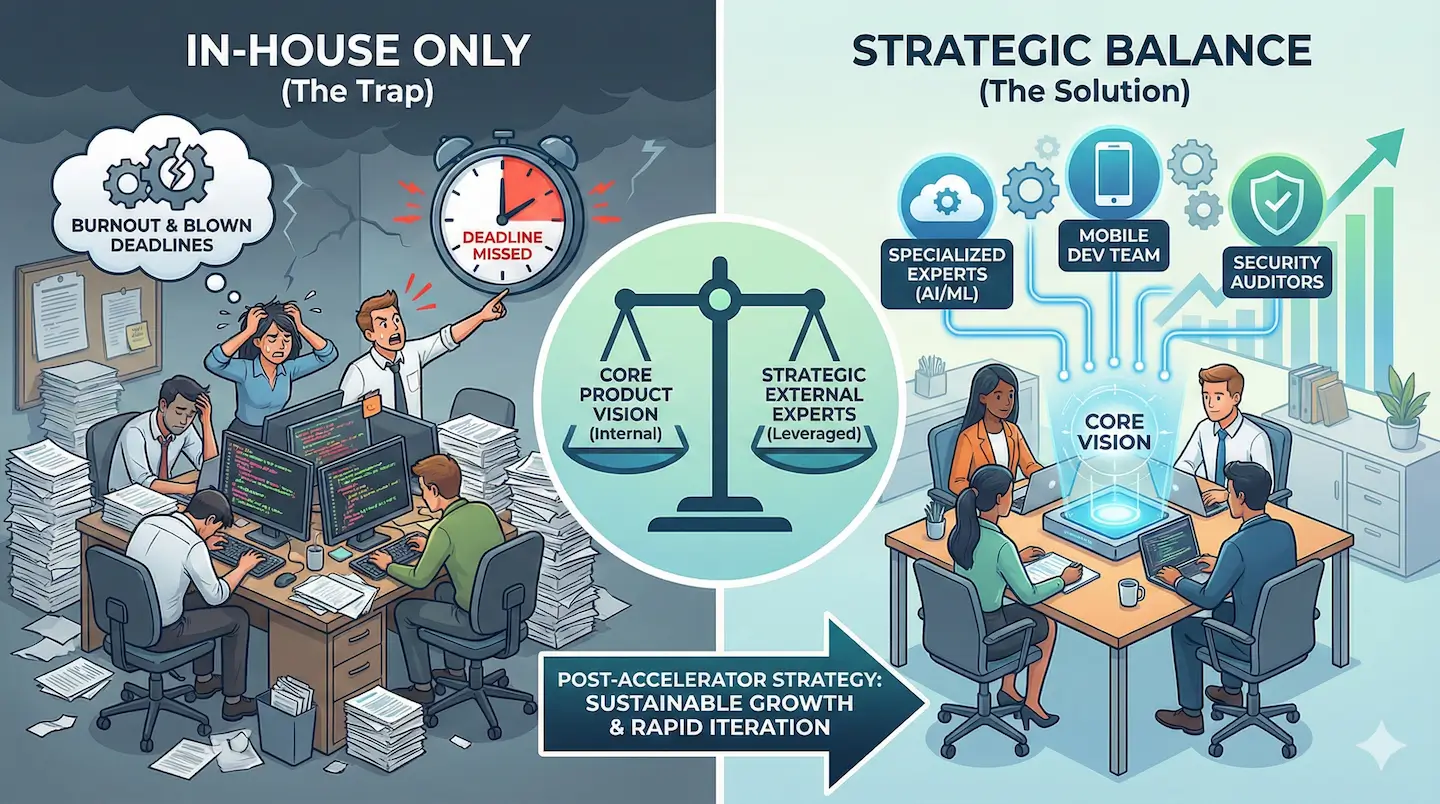
The Post-Seed Trap: Why You Can’t Build It All Internally
Building scalable, enterprise-ready software requires much more than just writing code. A mature product demands:
- Scalability and architecture planning
- UI/UX design that drives user retention
- Rigorous QA and automated testing
- Continuous security reviews to protect user data
- Ongoing legacy maintenance and support
For a lean startup team, juggling all of these competing priorities simultaneously is a recipe for disaster. It leads to developer burnout, sluggish release cycles, and missed market opportunities. Even well-funded, mid-size engineering teams hit inevitable bottlenecks when critical deadlines collide or highly specialized tech expertise is suddenly required.
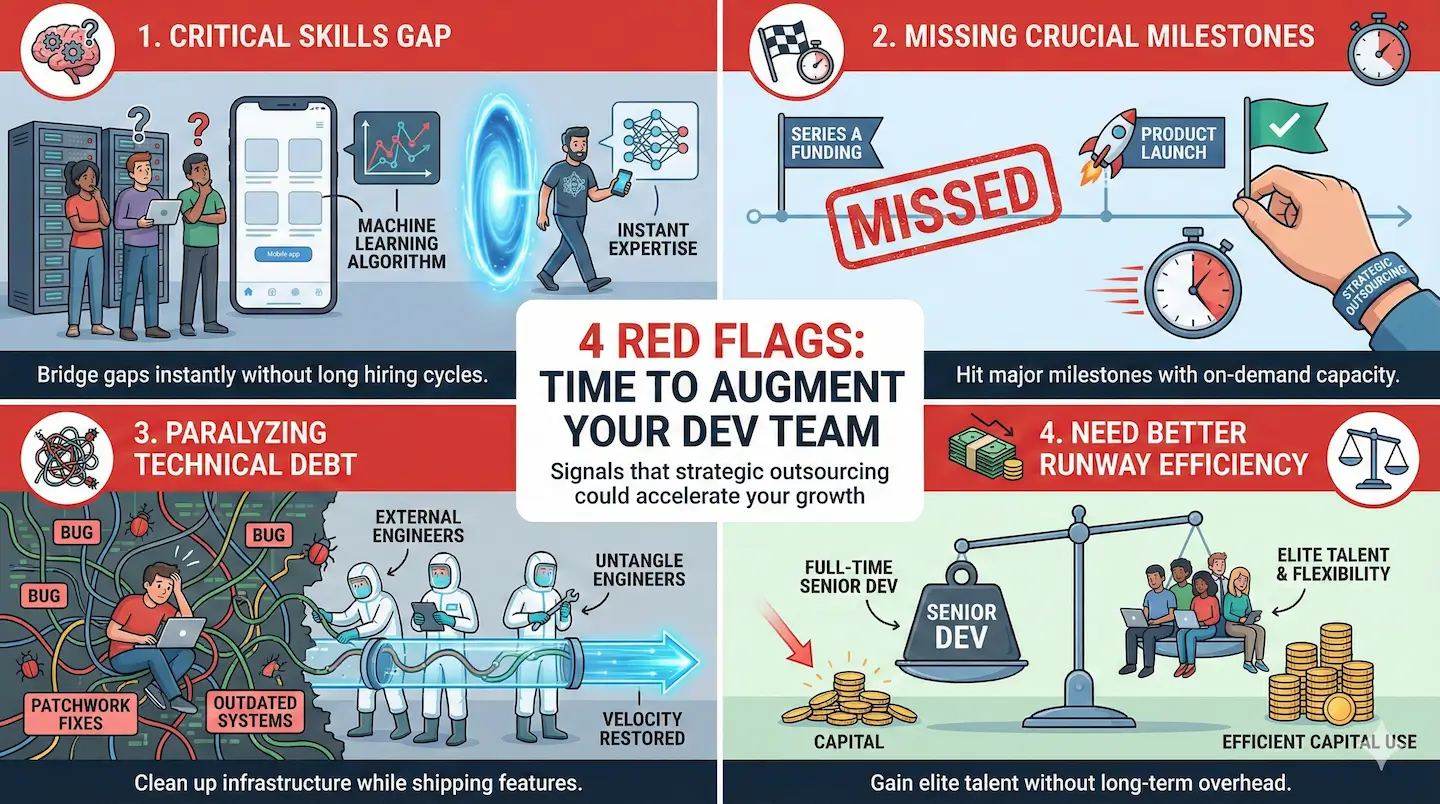
4 Red Flags It’s Time to Augment Your Dev Team
How do you know when your internal team is redlining? Look for these four signals that strategic outsourcing could accelerate your growth:
1. You Have a Critical Skills Gap: If your founding engineers are brilliant at backend architecture but lack deep expertise in mobile development, machine learning, or DevOps, outsourcing allows you to bridge that gap instantly without a month-long hiring cycle.
2. You're Missing Crucial Milestones: Upcoming Series A funding milestones, major product launches, or seasonal demand spikes often require more hands on deck than your current burn rate allows you to hire full-time.
3. Technical Debt is Paralyzing Feature Shipping: When patchwork fixes, minor bugs, and outdated systems begin to pile up, your velocity drops. Bringing in an external team to refactor and stabilize your codebase is a "cheat code" that allows you to clean up your infrastructure without losing any momentum on new feature development.
4. You Need Better Runway Efficiency: Hiring specialized full-time senior developers for short-term integrations or MVP builds is an inefficient use of capital. Outsourcing gives you elite talent and flexibility without the long-term overhead and benefits burden.
The "Core vs. Context" Framework: What to Outsource
A successful people-first outsourcing strategy relies on a simple rule: Keep your core product innovation in-house, and offload the rest.
Your internal team needs the mental bandwidth to focus on the features that actually differentiate your product in the market, rather than reinventing the wheel on backend infrastructure.
What you should outsource:
- Specialized Skills: AI/ML integrations, DevOps infrastructure, cybersecurity.
- Non-Core Work: QA automation, rigorous testing, legacy system maintenance.
- Short-Term Sprints: MVPs, API integrations, and backlog bug fixes.
How DevTeamsonDemand Scales High-Growth Startups
We don't just write code; we partner with technical founders to build resilient, scalable products. Our firsthand expertise focuses on:
- Application Rescue: Revitalizing stalled projects or broken codebases to get you back on track for launch.
- Legacy Upgrades & Maintenance: Modernizing outdated codebases (e.g., Node.js, Laravel) while maintaining zero downtime.
- Robust QA & Testing: Implementing automated testing and real-time monitoring to catch bugs before they impact your users.
- Tech Scaling & Team Building: Assembling and managing globally distributed engineering teams across time zones.
- Cloud Cost Optimization: Auditing and reducing your infrastructure spend to extend your runway.
- Leadership & Mentorship: Fostering strong team dynamics to ensure high productivity and retention among your engineers.
Final Thoughts: Empower, Don't Replace
Ultimately, strategic outsourcing isn’t about replacing your development team. It is about empowering them. By offloading non-core burdens, you give your engineers the freedom to innovate. The end result? Higher code quality, faster delivery times, and the ability to rapidly scale without burning out the people who built your company.
Don’t let technical debt or resource bottlenecks slow down your post-accelerator momentum.
Ready to extend your runway and accelerate development? Contact us to get the right engineering talent, exactly when you need it.