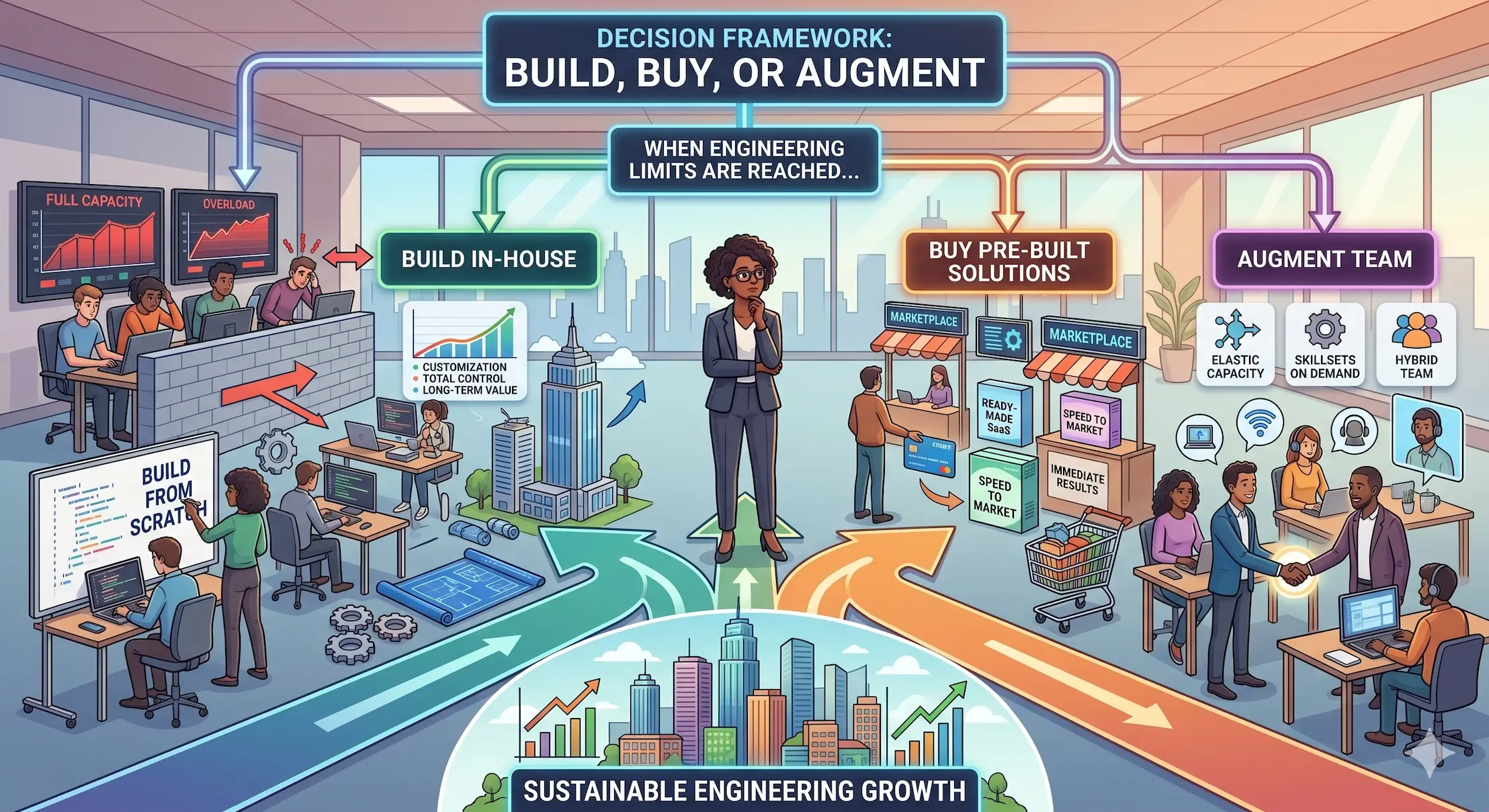
When your engineering team hits its limits, growth demands a decision: Should you build in-house, buy pre-built solutions, or augment with external developers? Each option has merit, and the right choice depends on your timeline, budget, technical debt tolerance, and business priorities. This article provides a pragmatic framework for CTOs deciding between these options in the real world.
The Case for Building: Control, Flexibility, and Long-Term Scalability
Building software in-house gives you full autonomy over your tech stack, features, and roadmap. It avoids vendor lock-in and makes it easier to maintain IP ownership. However, the time, cost, and complexity of hiring a team to build from scratch can be prohibitive, especially when senior engineers are in short supply.
On average, hiring a senior software developer takes three to six months, which can derail aggressive product roadmaps. Moreover, the cost of hiring an engineer in the U.S. averages $150,000 annually, not including benefits or recruiting expenses.
Build if:
- Your product requires highly customized, proprietary technology.
- You have a long development timeline.
- You’re ready to invest heavily in recruiting.
Avoid building if you’re unable to dedicate enough time and resources for prolonged hiring efforts. Otherwise, you risk choking operational agility and stalling critical initiatives.

Buying Off-the-Shelf: Speed, Cost-Effectiveness, but Limited Flexibility
Buying pre-built software or white-label solutions can kickstart your initiatives while saving significant time upfront. You bypass hiring challenges, enabling your team to focus on integrating the solution rather than reinventing the wheel.
However, off-the-shelf solutions often come with constraints. They may not align with your business logic, require extensive customization, or lock you into an ecosystem that limits flexibility. Further, ongoing subscription costs can outpace the long-term expenses of building your own custom solution.
Buy if:
- You need a quick go-to-market option.
- The software solution addresses your needs without major customization.
- Your team is stretched thin and cannot own additional responsibilities.
Avoid buying if your long-term scalability or differentiation hinges on tailoring the software. Vendor limitations can slow progress as your business evolves.

Augmenting Your Team: Speed and the Flexibility to Scale Up or Down
Staff augmentation gives you access to senior developers who embed directly into your workflows, reducing integration friction. Whether they are joining your existing engineers or serving as your primary development squad, a strong augmentation partner adapts to your processes—and can even provide the project management layer if you don't have it internally.
The advantage most CTOs overlook is the ability to scale down just as easily as you scale up. With full-time hires, you carry that salary every month regardless of project needs. When priorities shift or a product enters maintenance mode, reducing headcount means severance, morale damage, and lost institutional knowledge. Staff augmentation removes that rigidity. You can go from four engineers this month to two next month to one the month after, all without firing anyone or carrying costs you no longer need.
This flexibility is especially valuable post-funding, where burn rate matters. Instead of locking into a team size based on peak demand, you match engineering capacity to actual workload in real time.
Augment if:
- You need experts to accelerate development without committing to full-time hires.
- Your company is scaling rapidly post-funding and needs the flexibility to adjust team size as priorities shift.
- You're modernizing a legacy system that requires niche expertise in tools like React, Golang, or Kubernetes.
- You want to control costs by scaling engineering capacity up or down without layoffs.

Combining Strategies for Maximum Impact
In reality, successful CTOs know that scaling engineering capacity isn’t an either/or decision. Sometimes, a hybrid approach can deliver optimal results. For example:
- Pair a bought solution with augmented developers for faster integration and customization.
- Augment your team short-term while you hire full-time engineers for a sustained long-term build strategy.
- Develop a mix of custom, in-house features and leverage SaaS products for non-core processes.
By carefully evaluating costs, risks, and timeline constraints, CTOs can strategically craft a blended approach that balances speed, flexibility, and scalability.
Scaling engineering capacity isn’t just about addressing immediate resourcing gaps. It’s about making decisions that enable long-term success and maintaining focus on your core business objectives. At Dev Teams On Demand, we specialize in helping companies solve these challenges by providing pre-vetted senior engineers who can integrate seamlessly into your existing workflows. When you’re ready to stop searching and start building, visit Dev Teams On Demand.