.webp)
Quality Assurance (QA) is often misunderstood.
In most organizations, it’s treated as a final checkbox, a gatekeeper that stands between development and deployment. Newsflash! If this is how your team views QA, you are likely already seeing cracks in your product quality.
Good QA isn't just about finding bugs, it’s about preventing them.
Your QA process is the essential safety net for your entire operation. It safeguards your user experience, protects your brand reputation, and maintains your development speed.
However, when this crucial safety net breaks down, the consequences are significant: highly frustrated users, damaging negative reviews, and a development team trapped in an endless cycle of emergency hotfixes. Ultimately, this perpetual firefighting severely impedes progress on releasing new product features.
How do you know if your current process is broken?
Here are 5 unmistakable red flags that your QA strategy needs an overhaul, and actionable steps to fix them.
1. Users Are Reporting Bugs Before You Find Them
You release a feature with confidence, only to have your support tickets spike within hours. Your users are stumbling onto edge cases or broken workflows that your team completely missed.
Why It Happens: This usually signals that your test coverage is too shallow or too focused on the "happy path" (the ideal user journey). Automated tests might be passing, but they aren't mimicking real-world behavior.
The Fix: Prioritize key flows and exploratory testing by moving away from strictly scripted test cases. Encourage your testers to actively "break" the software through unpredictable behavior, mimicking how a real user interacts with your product.
Action: Map out your top 5 critical user flows (e.g., Checkout, Sign Up, Data Export) and ensure they have 100% regression coverage. Then, allocate dedicated time for unscripted exploratory sessions to catch the oddities that scripts miss.
%201.webp)
2. QA Is Always "Chasing" Development
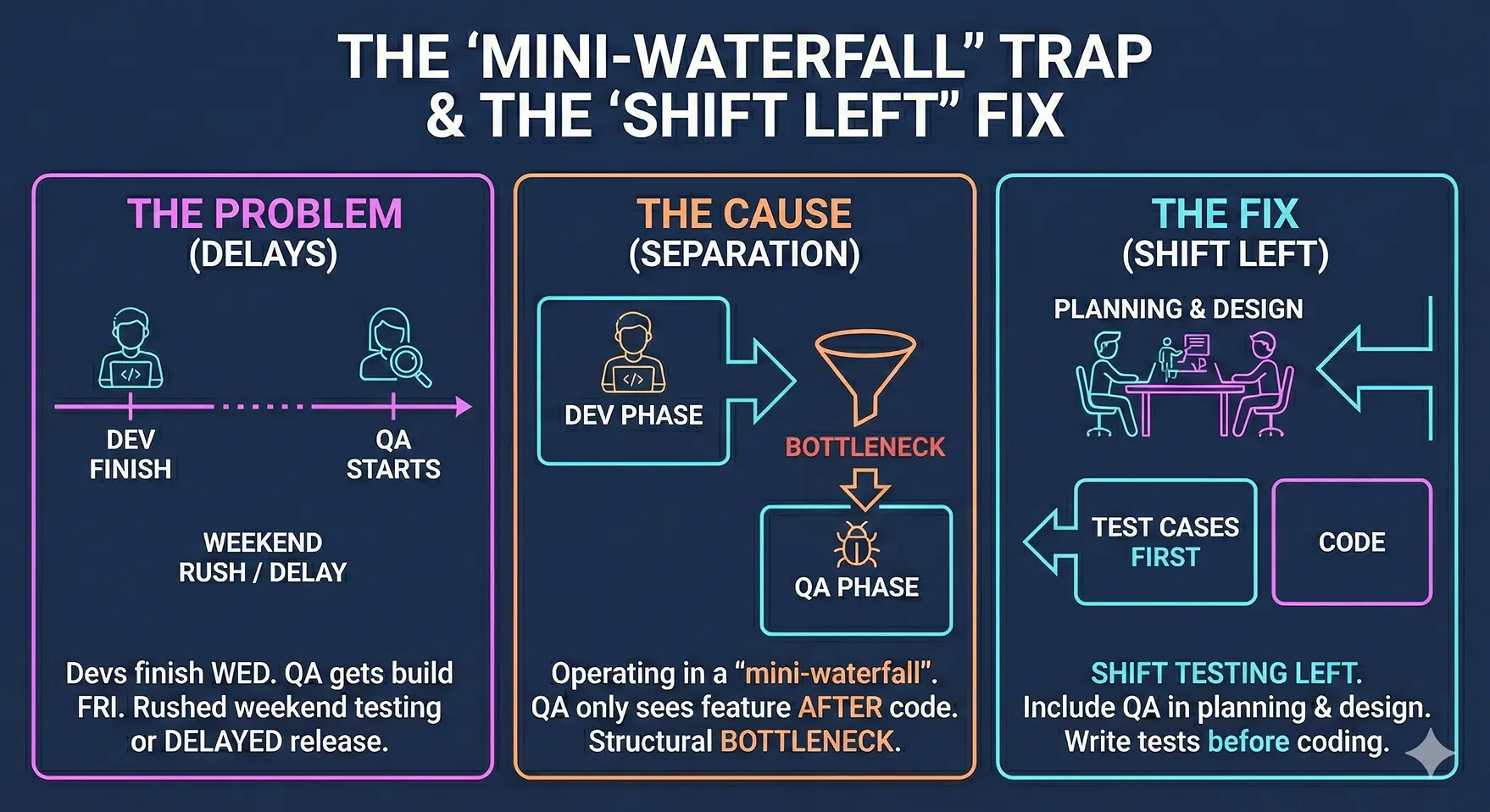
Developers finish their sprint on Wednesday, but QA doesn't get the build until Friday afternoon. The result? A rushed testing phase over the weekend or a delayed release.
Why It Happens: You are likely operating in a "mini-waterfall" model within an Agile environment. If QA only sees the feature after code is written, they are structurally set up to be the bottleneck.
The Fix: Reduce bugs by shifting testing left, which simply means moving your quality checks earlier into the development lifecycle. This ensures QA is actively involved during the requirements and design phases rather than waiting until the execution stage.
Action: Include QA engineers in sprint planning and design reviews. Let them write test cases before the code is written. This allows developers to build software that passes the test the first time, reducing the back-and-forth volley of bugs.
3. Your Testing Is Mostly Manual
Your regression suite takes three days to run because humans have to click through every single screen. As your product grows, your release cycles get longer, not shorter.
Why It Happens: Reliance on manual testing scales linearly, you need more people to test more features. It is slow, prone to human error, and demoralizing for testers who have to repeat the same tasks endlessly.
The Fix: Focus on automating high-impact test cases while keeping in mind that you cannot and should not automate everything, but you must automate repetitive tasks to truly scale your efforts.
Action: Adopt the Test Pyramid strategy. Build a solid foundation of fast Unit Tests, a middle layer of Integration Tests, and a smaller, strategic layer of UI/End-to-End automated tests for critical paths. This frees your human testers to focus on complex, creative testing that machines can't do.
.webp)
4. There is No Clear "Definition of Done" (DoD)
A developer marks a ticket as "Done," but QA rejects it immediately because it breaks on mobile, or it lacks basic error handling. Arguments ensue about what was actually required.
Why It Happens: Ambiguity. If "done" means "it works on my machine" to a developer, but "it works on all devices and passes regression" to a QA, you have a misalignment that wastes time.
The Fix: Work to standardize your criteria by establishing a shared agreement on what quality looks like before any ticket can move to the next stage.
Action: Create a checklist for your DoD. For example: Code reviewed? Unit tests passed? deployed to staging? smooth UI on mobile? If a feature doesn't tick every box, it isn't done. This aligns expectations and prevents half-baked features from clogging up the QA pipeline.
.webp)
5. Feedback Loops Are Too Slow
A developer writes code on Monday. QA finds a bug on Thursday. By then, the developer has moved on to a different task and has to "context switch" back to Monday's work, digging through mental archives to remember the logic.
Why It Happens: Lack of Continuous Integration (CI). When feedback comes days later, the cost of fixing a bug increases exponentially due to the loss of context.
The Fix: Integrate QA into your CI/CD pipeline so that feedback is instantaneous and automated tests run immediately whenever code is committed.
Action: Integrate your automated test suite into your CI/CD pipeline (e.g., Jenkins, GitHub Actions). If a pull request breaks a test, the build should fail automatically, alerting the developer within minutes not days.
.webp)
Quality is a Catalyst, Not a Bottleneck
A strong QA process doesn’t slow delivery down, it actually makes you faster. By catching issues early, automating the repetitive work, and aligning your team on quality standards, you build a highway for high-speed, high-confidence releases.
Your product, your team, and your users deserve a process that works.

Need Help Scaling Your QA?
You’ve built a product. Now, the next challenge is scaling it without breaking it, or your team.
At DevTeamsOnDemand, we partner with CTOs and Founders from high-growth environments (like YC and Techstars alumni) to engineer bulletproof quality systems that scale ahead of your development pace. We don't just fix symptoms; we embed the automated frameworks, "shift-left" strategy, and specialized dev power you need to transition from perpetual firefighting to high-velocity, high-confidence releases.
Your QA process should be an accelerator, not a drag on your roadmap.
Ready to transform QA from a bottleneck into your most powerful growth tool?[Schedule a Technical Consultation with Our Specialists]