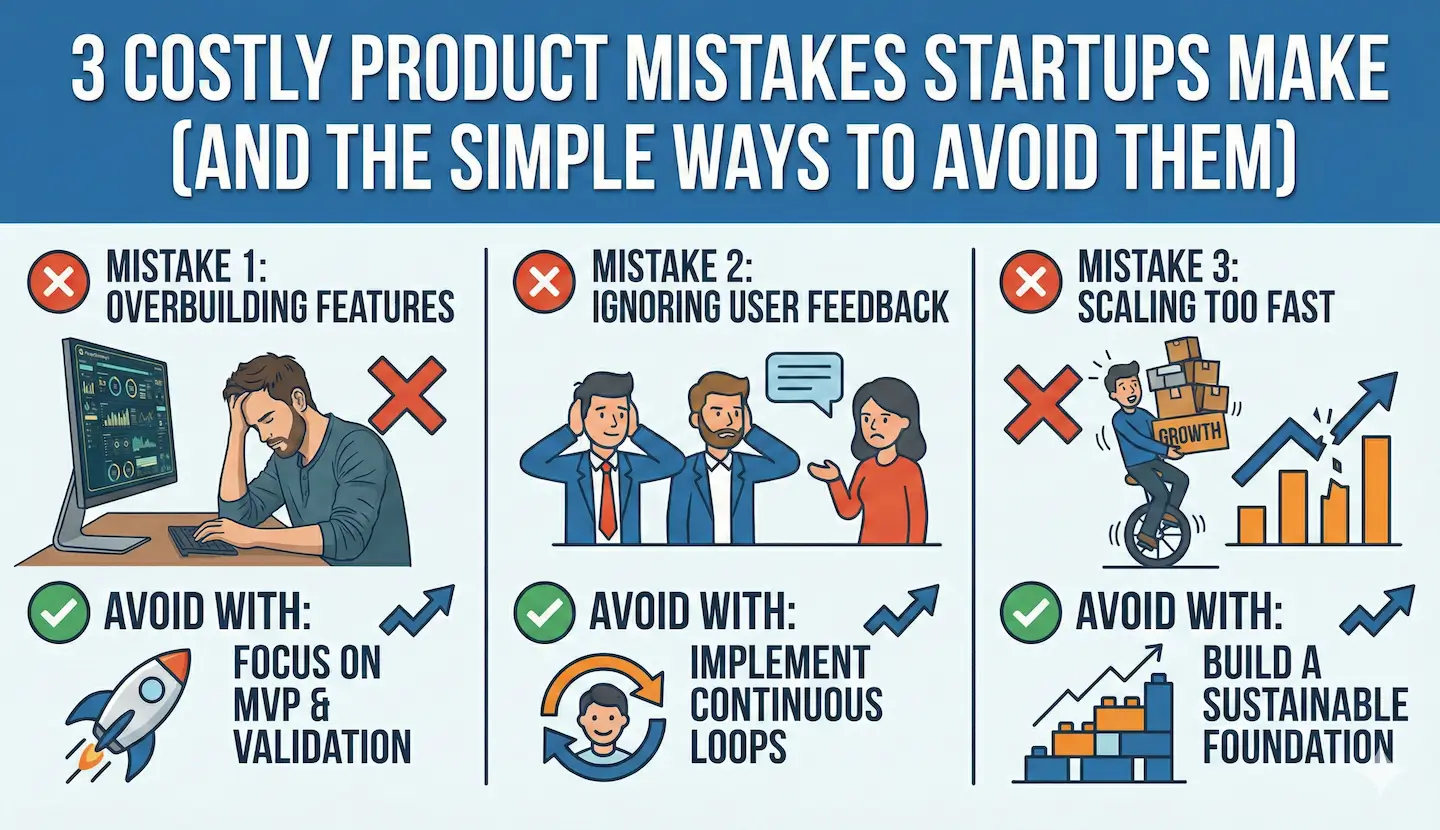
For a startup, an innovative product is everything. It’s the engine, the pitch, and the ultimate measure of success. Yet, the journey from brilliant idea to market-ready software is littered with common, often fatal, missteps. We've compiled the most important lessons learned by others to help you avoid the costly product mistakes startups make that routinely drain resources and derail even the most promising ventures.
Having partnered with many tech founders at Dev Teams On Demand (DTOD), we’ve identified the key patterns that dictate success. We know exactly what separates the products that win from the ones that fail.
Here are the three most common product mistakes we see startups make, along with the actionable strategies you can use to avoid them.
Mistake #1: Building a Solution Before Validating the Problem
This is the most dangerous trap: falling in love with your idea before confirming the market actually needs it.
Many founders are so enthusiastic about their vision that they skip or rush the crucial customer discovery phase. The result? They spend months and thousands of dollars building a high-tech product that is ultimately a solution looking for a problem. "No market need" remains a top reason for startup failure.
🛑 How This Mistake Shows Up
- Skipping Market Research: Relying on gut feeling instead of data.
- Ignoring the Target User: The product is designed for what you think is cool, not what the customer actually struggles with.
- Vague Requirements: Developers are working on assumptions, leading to wasted time and feature rework.
✅ How to Avoid It: The Power of Proof
The solution is to embrace the Lean Startup methodology from day one. You need to prove the pain before you invest heavily in the cure.
- Conduct Structured Customer Interviews: Talk to at least 10-15 potential users. Don't pitch your solution; ask about their existing challenges, frustrations, and the tools they currently use.
- Build a Minimum Viable Product (MVP) Slice: Not a "mini product" with every feature, but the smallest possible thing that solves the core problem for a narrow user segment. The goal is to learn and iterate, not to launch a polished final version.
- Test with Data, Not Assumptions: Use early user feedback and analytics (e.g., usage rates, drop-off points) to validate that your product is solving a real, felt need.

Mistake #2: Over-Engineering the MVP (Minimum Viable Product)
The MVP is meant to be lean, fast, and a mechanism for learning. However, many startups driven by perfectionism or the fear of launching something "unpolished" end up building an over-engineered behemoth.
This phenomenon, often called "Feature Creep," drains critical seed capital and delays your most important task: getting user feedback.
🛑 How This Mistake Shows Up:
- Delayed Launch: The MVP takes 6 to 9 months instead of the planned 6 to 8 weeks.
- Bloated Codebase: Building complex infrastructure or features for future scale that may never materialize.
- Misaligned Resources: Too much time is spent on non-essential "bells and whistles" (e.g., advanced reporting, complex integrations) instead of the core user journey.
✅ How to Avoid It: Focus on the Minimum Lovable Product (MLP)
Shift your mindset from "Viable" to "Lovable." The goal isn't to be feature complete; it's to create an exceptional experience around one core function.
- Define Your "One Thing": Clearly articulate the single, most valuable action a user can take in your product. Every feature in the MLP must directly support this "one thing."
- Embrace Technical Debt (Temporarily): Don't build the perfect, scalable architecture for $10 million in users yet. Use a foundational, flexible stack that allows for rapid development. Your focus should be on product market fit, not perfect code.
- Use the 80/20 Rule on Features: Identify the 20% of features that will deliver 80% of the value. Ship only those. The rest can wait for Version 2.0 and beyond.

Mistake #3: Neglecting Scalability and Code Health for Speed
While speed to market is critical, some startups prioritize a rapid launch so heavily that they introduce crippling technical debt issues in the code that make it progressively harder and more expensive to maintain and update.
This results in a product that can't handle growth. Once you hit that first wave of success, your engineering team is immediately stuck firefighting legacy code instead of building new, requested features.
🛑 How This Mistake Shows Up:
- Slow Performance: The app bogs down with only a small increase in users.
- Fragile Releases: New feature deployments frequently break existing functionality.
- Skyrocketing Costs: Developers spend more time fixing old issues than building new value.
✅ How to Avoid It: Build Smart, Not Just Fast
You need a development approach that balances speed with long-term stability.
- Invest in a Solid Foundational Architecture: Your core data models and service layers should be well thought out and extensible. This doesn't mean over engineering, but rather making smart technology choices that support growth.
- Prioritize a Professional DevOps Culture: Implement continuous integration and continuous deployment (CI/CD) from the beginning. Automated testing and clear code review processes catch errors early, preventing technical debt from piling up.
- Partner with Expertise: If you lack senior-level, fullstack talent in-house, consider bringing on a seasoned external team. Their expertise can ensure your foundation is clean, scalable, and built for the future, saving you exponential costs down the road
.jpg)
Build Your Product Right, from the Ground Up.
The difference between a successful startup product and a failed one often comes down to how you build it. It’s about discipline, focus, and a commitment to customer validated iteration.
At Dev Teams On Demand, we provide the experienced, senior-level developers, architects, and designers your startup needs to avoid these costly mistakes.
Ready to stop gambling on your product and start building a foundation for success?
➡️ Contact Dev Teams On Demand Today